

Coordinating inclusive health outreach in Meru County
Stories | Published: January 19, 2026
For many households in Meru’s rural and remote areas, basic health services are physically distant, financially burdensome, or simply inaccessible. For people with disabilities, the barriers multiply – limited mobility, lack of accessible information and facilities, and long-standing stigma can make it nearly impossible to receive timely care.
Families often keep children with disabilities at home because they don’t know where to seek support. Others travel great distances to facilities that may not have the equipment, training, or environment to meet their needs. In such communities, health inequities take root and deepen over generations.
To help close the gap in accessible healthcare, CBM Australia is supporting a project that embeds inclusive health and wellbeing within communities using a Community-Based Inclusive Development (CBID) framework.
Implemented by CBM partner, Diocese of Meru – Service for the Poor in Adaptive Rehabilitation Kinship (DOM SPARK) and delivered in partnership with the County Government of Meru, the project is anchored on three essential Foundations for Inclusion:
- Empowerment and community mobilisation : People with disabilities are empowered to connect, learn about their rights, and engage with local and national government.
- Accessibility : From physical spaces to information and service delivery, the project works to strengthen standards and ensure access for all community members.
- Disability support services and assistive devices : The project strengthens systems to provide inclusive education, economic empowerment, and disaster risk reduction.
At its core is a simple belief:
When communities are equipped with knowledge, tools, and agency – and when governments are strengthened to deliver evidence-based policies – health systems become more inclusive for people with disabilities and other service seekers.
Coordinated outreach in action
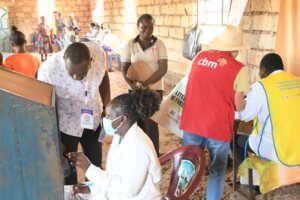
To improve access to health services in rural and remote areas, DOM SPARK collaborates with the County Ministry of Public Health and Organisations of People with Disabilities (OPDs) to deliver comprehensive outreach events.
These events are more than mobile clinics. They are carefully crafted, community-driven operations that include:
Community mobilisation
Announcements go out through multiple channels—churches, radio shows, and sound trucks. Churches, trusted and deeply rooted in community life, play a crucial role in spreading the word and encouraging participation.
Service coordination
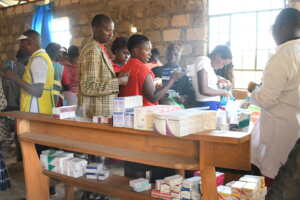
Multiple meetings are held to organise practitioners and service providers. On the day of outreach, a full spectrum of services is offered, including:
- Vaccinations
- Antenatal care
- Sexual and reproductive health services
- Tuberculosis and HIV screening
- Blood pressure and diabetes monitoring
- General health consultations
- Eye health screening by DOM SPARK’s ophthalmic team
- Psychological support
- Disability assessments and registration
- Medication distribution and health education
These aren’t merely services – they are lifelines, especially for people who have never had access to healthcare.
Outreach snapshot
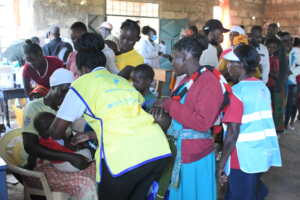
Early on the day of outreach, people began making their way toward the project outreach site. Parents with children and community members arrived with a shared hope: access to health services that often felt out of reach. By 6:30 AM, the first families were waiting. Within a few hours, more than 370 people had registered for care.
The event was buzzing with activity, drawing participants from nearby villages. For people with disabilities, the event marked a turning point: disability assessments and registration were finally available close to home, opening the door to future support.
One participant captured the sentiment shared by many:
“We are now somewhere we were not before. Our children are being assessed, registered, and supported. We no longer hide them—we empower them.”
For families who once felt isolated, the outreach brought visibility, dignity, and hope.
A model for sustainable, inclusive health
This project shows that inclusive health is not created through one-off events but through coordinated, community-led action. By bringing together like-minded groups, empowering OPDs, and aligning with county health systems, the project is creating a sustainable model for inclusive health and wellbeing in Meru County. And for the hundreds of people who gathered at dawn for services they had been waiting for, it is a life-changing step toward a healthier, more empowered future.
CBM Australia acknowledges the support of the Australian Government through the Australian NGO Cooperation Program (ANCP).
https://www.cbm.org.au/stories/coordinating-inclusive-health-outreach-in-meru-county
Related Stories
Building stronger eye health systems in Indonesia
Discover how the I-SEE Phase II project improved access to quality eye care in East Nusa Tenggara
Celebrating World Cerebral Palsy Day with Stevie
Discover Stevie's five tips for inclusive development and learn how to build more accessible communities this World Cerebral Palsy...
Seeing Beyond the Stigma: How one doctor is helping change attitudes to mental health in the Philippines
Meeting people beyond the stigma changed Dr Arman's life....