

New Horizons: Changing Livelihoods, Changing Lives
Stories | Published: July 15, 2026
New Horizons: Changing Livelihoods, Changing Lives
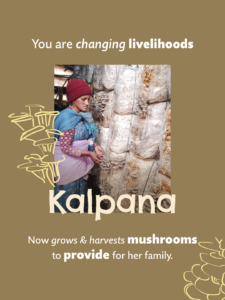
Kalpana can now tend to her mushroom while also looking after her family.
In Karnali Province, Nepal, life has never been easy. The region is remote, services are far away, and most families depend on small‑scale farming. Income is uncertain and often seasonal. For women, people with disabilities and those who care for them, daily life brings even greater challenges.
In November 2023, a powerful earthquake made life even harder. Homes were damaged, farmland was disrupted, and many families lost their sense of safety and stability. For the most vulnerable, recovery felt out of reach.
This is where the stories of Kalpana and Puspa begin.
Kalpana lives in a rural village with her husband and children. One of her children has a physical and speech‑related disability, and Kalpana is his main caregiver. Before receiving support through a CBM project, her family survived on small‑scale farming. The income was irregular and rarely enough for healthcare, nutrition, or emergencies. Kalpana worked constantly in the home and on the farm, yet she had little say in financial decisions and worried endlessly about the future.
Through CBM’s earthquake recovery and livelihoods program, Kalpana received support to start mushroom farming. The work could be done close to home and allowed flexible hours, making it possible to balance caregiving with income generation. Unlike seasonal crops, mushrooms provided a more stable, year‑round income.
As the business grew, Kalpana’s role within her family changed. She became recognised as someone who contributed financially and participated in decision‑making. With steady income, she could plan ahead for her child’s health needs and her family’s security. Neighbours began to see her not only as a caregiver, but as a businesswoman.
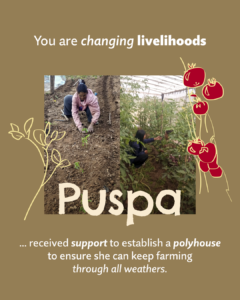
(left) Puspa busy planting seedling in her polyhouse. (right) Puspa with CBM’s partners livelihood officer.
Puspa lives in another village with her father, who also has a disability. She has a physical disability herself and had always relied on farming for income. Open‑field farming exposed her crops to heavy rain, pests, and repeated losses. Despite her hard work, her income remained unstable, and she was often seen as dependent rather than capable.
After the earthquake, Puspa received support to establish a polyhouse for vegetable farming. The protected structure reduced physical strain and shielded crops from harsh weather and pests. With adaptive tools and a controlled environment, farming became more predictable and manageable.
As her crops improved, so did her confidence. Puspa began speaking up in community meetings and sharing her experience. She now describes herself as a self‑employed farmer. Slowly, perceptions around her began to change.
Kalpana and Puspa’s journeys reflect CBM’s livelihoods graduation approach – a step‑by‑step pathway from vulnerability to stability and then toward long‑term independence. Their livelihoods brought more than income. They gained confidence, respect, and greater control over their lives.
https://www.cbm.org.au/stories/new-horizons
Related Stories
Building climate resilience for people with disabilities in Nepal
Read about how climate resilience Nepal initiatives helped people...
From Isolation to Belonging: Yesua’s Journey
Discover how disability inclusion transformed Yesua's life, helping him overcome exclusion, build confidence, advocate...
A small shop with a big future
Inclusive livelihoods in Indonesia helped Dasirah build a small business, support her family and create a more secure future in Aceh.